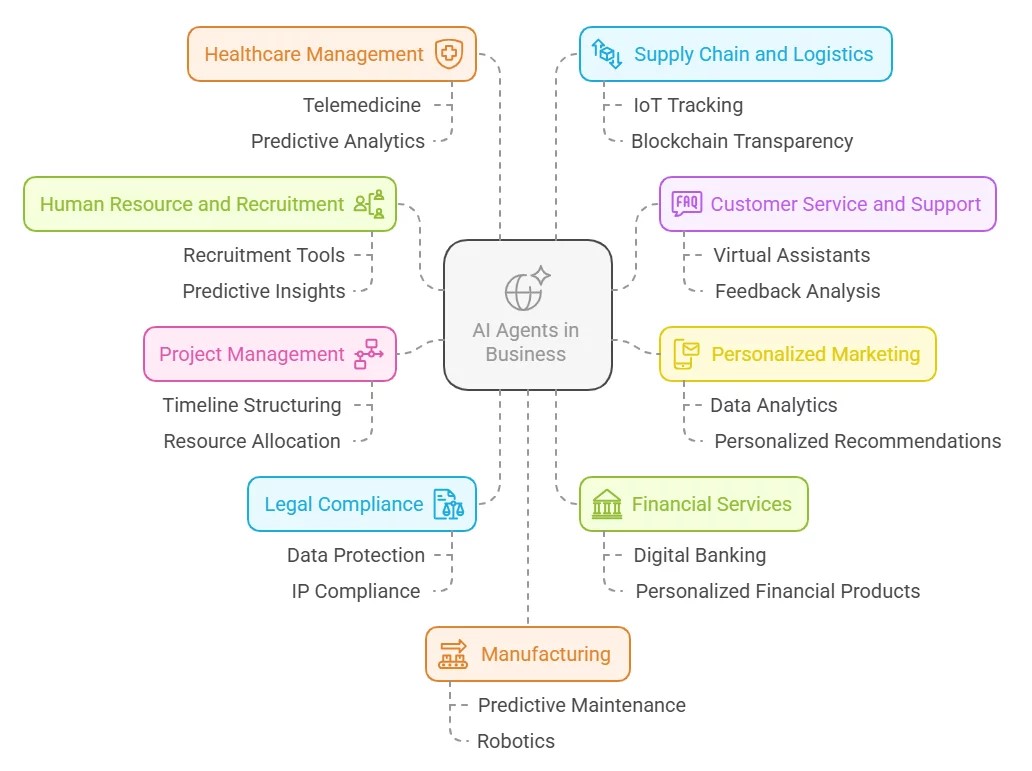

Artificial Intelligence (AI) is transforming industries by enabling automation and intelligent decision-making. AI agents, designed to operate independently, range from simple automated programs to advanced machine learning models that adapt to their environment. These agents perform tasks such as data processing, decision-making, and problem-solving. Equipped with algorithms, they analyze information, learn from interactions, and make informed decisions based on predefined rules and new insights. This article describes 15 real-world case studies showcasing how AI Agents are transforming businesses across diverse industries.
15 AI Agents Case Studies
AI agents are revolutionizing businesses by automating tasks, improving efficiency, and enhancing decision-making. Here are 15 real-world case studies showcasing AI agents' impact across various industries.
1. Human Resource and Recruitment
Advancements in HR and recruitment technologies have revolutionized how organizations manage their workforce and hiring processes. These innovations enable a more efficient and structured approach, streamlining everything from recruitment to employee management. Applicant Tracking Systems (ATS) play a crucial role in hiring by organizing job postings, filtering applications, and tracking candidates throughout the recruitment cycle.
AI and machine learning are increasingly integrated into HR systems, enabling predictive insights such as employee turnover forecasts, leadership identification, and workforce optimization. Technologies like IBM’s Watson Talent exemplify how AI-driven HR solutions enhance decision-making and strategic planning.
2. Customer Service and Support
AI agents are transforming customer service by delivering fast, consistent, and 24/7 support. These AI-driven virtual assistants and chatbots handle a wide range of customer queries, from answering FAQs to managing transactions, reducing wait times and enhancing personalization while cutting operational costs.
Companies like Amazon and Zappos utilize AI to improve customer experiences. Amazon’s Alexa, for instance, assists with shopping, smart home controls, and real-time information, boosting user engagement.
3. Personalized Marketing
Targeted marketing uses data and technology to deliver highly relevant messages tailored to individual customer preferences, behaviors, and purchase history. This strategy enhances customer engagement while significantly improving the impact of marketing campaigns.
Companies like Amazon leverage customer data to offer personalized product recommendations. Automated tools such as Mailchimp enable businesses to send customized emails at scale based on user behavior.
4. Project Management
Project management involves planning, executing, controlling, and completing a team’s work to achieve specific objectives within set constraints. The main challenge is ensuring that all project goals are met within the allocated time, budget, and resources.
Project management tools like Microsoft Project and Asana assist in structuring timelines and assigning responsibilities. Effective communication is essential throughout the project lifecycle.
5. Legal Compliance
Ensuring legal compliance in business operations involves following relevant laws and regulations, including those related to employment, consumer protection, data privacy, and intellectual property. Compliance helps reduce legal risks and builds trust with customers and partners.
Regulations such as GDPR in Europe and CCPA in the United States require businesses to handle personal data responsibly.
6. Financial Services
The financial services industry plays a vital role in the global economy, covering banking, insurance, investment firms, and accounting. Technology is transforming this space, with fintech innovations reshaping how people bank, invest, and manage transactions.
Digital banking, AI fraud detection, blockchain security, and personalized financial products are key developments in the sector.
7. Healthcare Management
Healthcare management oversees the administration and operations of hospitals, clinics, and medical facilities. Innovations like electronic health records (EHRs), telemedicine, and AI-driven diagnostics are transforming healthcare delivery.
AI-powered predictive analytics help forecast disease outbreaks, hospital admissions, and resource needs.
8. Supply Chain and Logistics
AI-driven solutions are revolutionizing supply chains by optimizing the movement of goods from manufacturing to final delivery.
IoT devices enable real-time tracking, blockchain improves transparency, and analytics optimize routes and inventory management.
9. Manufacturing
AI is transforming manufacturing by increasing efficiency, lowering operational costs, and enhancing product quality.
Predictive maintenance helps prevent equipment failure, while AI-powered robots automate repetitive tasks.
10. Security and Surveillance
AI is enhancing monitoring and response capabilities through technologies like facial recognition and anomaly detection.
AI-powered surveillance systems analyze CCTV footage in real time, helping detect threats faster.
11. Research and Development
AI is accelerating innovation in pharmaceuticals, materials science, and environmental research.
AI algorithms predict drug efficacy, discover new materials, and model climate data for future planning.
12. AI in Travel and Hospitality
AI is revolutionizing travel and hospitality by personalizing customer experiences and improving operations.
AI chatbots handle bookings and support, while smart assistants and robots enhance hotel guest services.
13. AI in Software Testing
AI-driven systems in software testing use machine learning and automation to improve testing efficiency.
AI supports regression testing, defect prediction, test case generation, and anomaly detection.
14. Content Creation
Content creation involves developing topics, producing written or visual material, and distributing it through blogs, videos, and social platforms.
AI tools help with writing, editing, graphics, SEO optimization, and trend discovery.
15. Real Estate Management
AI is transforming real estate by automating lease management, maintenance scheduling, and customer interactions.
AI-driven analytics also help evaluate market trends, property values, and investment opportunities.
Final Thoughts
The future of AI is set for remarkable advancements through integration with quantum computing and the Internet of Things (IoT). This convergence will enhance AI’s capabilities across industries such as healthcare, automotive, and manufacturing.
Additionally, ethical AI will become more important. Ensuring fairness, transparency, and reducing bias will drive stronger regulations and responsible AI adoption worldwide.